
Hockley County Felony Warrant Route
Felony cases in Hockley County belong to the 286th District Court, which also serves Cochran Counties. Its clerk is the District Clerk, who keeps the district, felony, and family files. County-court criminal matters go a different way. Those route through the County Clerk instead, so match your warrant question to the case level rather than to a courthouse address. The court's own page names Judge Anna D. Hord, lists a court coordinator, and places the court office at the courthouse. What it does not offer is a warrant lookup, and no local bond schedule appears there either. If the warrant is an unknown Hockley County arrest warrant, call the sheriff at 806-894-3126. That number is the public contact the office labels for warrants, and the court's official page spells out the 286th District Court route.
Hockley County Arrest Warrants Explained
An arrest warrant is a written order from a magistrate. It directs an officer or named person to take an accused into custody. Texas law sets the process, and Hockley County publishes no local warrant application or sample entry. The paperwork begins with a complaint or affidavit. A magistrate reviews the facts it presents. If the legal basis is met, the magistrate may issue a warrant or a summons. The sheriff, a constable, or city police may serve it. Another peace officer can too, all according to the order and Texas law.
Hockley County Arrest Warrant Fields
Texas Code of Criminal Procedure Article 15.02 sets what an arrest warrant must contain. It must identify the accused by name or a reasonably definite description. It must state the offense. And it must bear the magistrate's signature and office. Those requisites come from statute, not from a Hockley County database screen. The county publishes no local number format or sample record. Ask for the cause and warrant identifier too. When you request a copy, ask the court or sheriff for the issuing authority, the service status, and any public supporting affidavit. Access still bends to juvenile, sealed, and other legal limits. Texas Code of Criminal Procedure Chapter 15 holds the warrant provisions.
Inside a Hockley County Arrest Warrant
Hockley County publishes no sample arrest-warrant record. No schema, no local warrant number, no public bond field. When a court or agency confirms a record, ask what identifies it, which authority issued it, and whether service is complete.
| Warrant Number | Format not published Request the court's identifier. |
|---|---|
| Named Subject | Article 15.02 requires a name if known or a reasonably definite description. |
| Charge / Offense | The warrant must state the offense. |
| Issuing Judge / Court | Ask for the issuing magistrate and court that controls the case. |
| Bond / Bail Set | No Hockley defendant bond schedule was located. Confirm amount and type. |
| Date Issued | Ask whether a date is available in the public record. |
Who Serves Hockley County Warrants
The Hockley County fee schedule lists service categories for sheriff and constable work: criminal warrant, capias, and capias pro fine. What it never shows is which officer carries a particular order. The Levelland Police Department works out of the same law-enforcement center. It offers no city warrant portal and no direct warrant line. The sheriff's page lists 1310 Avenue H in Levelland. The main phone is 806-894-3126. The jail number, 806-894-9334, routes custody questions, not warrant lookups. Call first. The county does not say that walk-in surrender or bond is accepted at a public counter.
The sheriff page shows the county law-enforcement contact used for warrant routing:
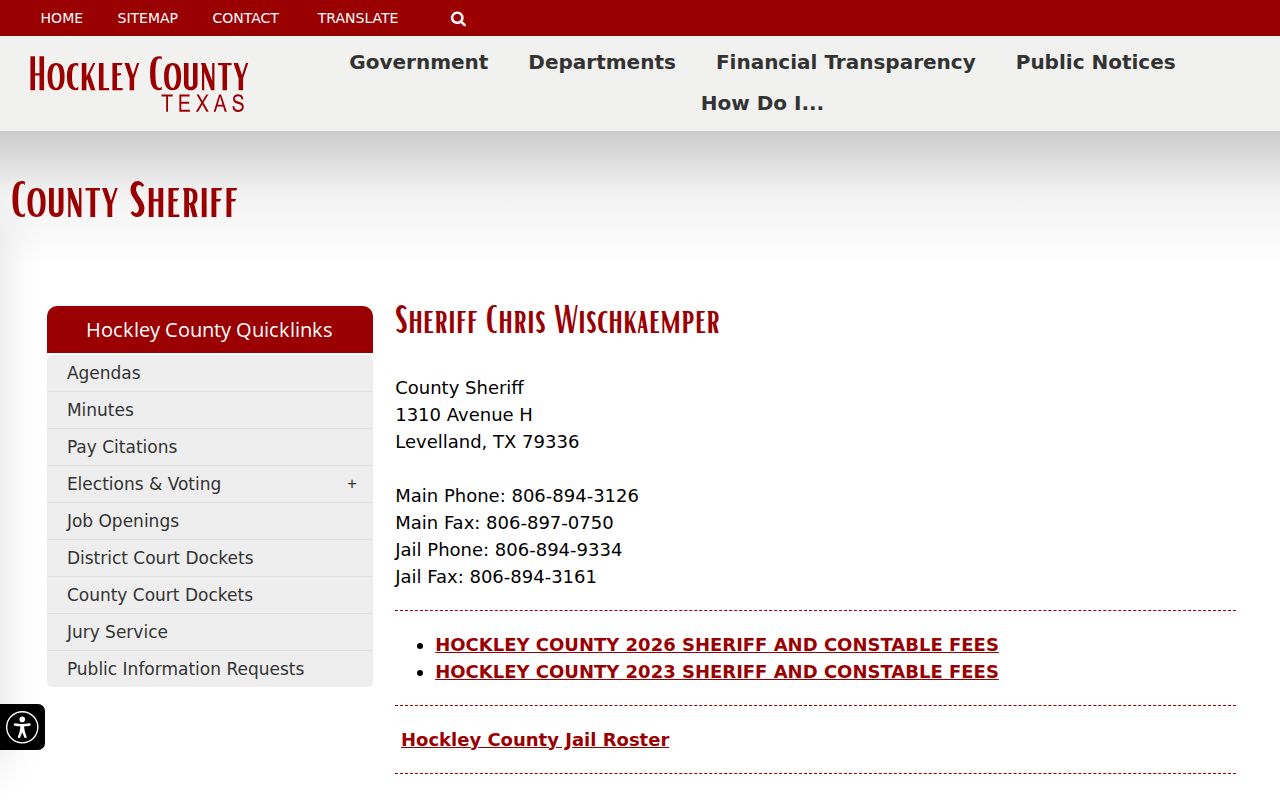
Ask which office holds the order and what it can confirm before traveling.
Serving Arrest Warrants in Hockley County
In Hockley County, a peace officer serves an arrest warrant under the order and Texas law. The fee schedule confirms the local service categories. It publishes no duty roster or schedule. A city police department may serve city or magistrate process. The sheriff and constables have service roles too. After an arrest comes booking and a magistrate appearance. The required proceedings follow from there. Hockley County posts no magistration timetable, bond schedule, or jail payment instructions. Before a planned appearance, call the issuing court, the sheriff, or a lawyer. Confirm the right location and process first.
Hockley County Warrant Fee Is Not Bond
Hockley County's 2026 schedule lists $75 for criminal-warrant service, $75 for capias service, and $75 for capias-pro-fine service. Those are officer process fees. They say nothing about release. They do not state how much a person must post, whether bond is available, or where payment is accepted. The 286th District Court page lists its coordinator and court phone, 806-894-8240. Bond type, amount, and appearance questions go there or to a lawyer. Ask about any planned surrender too. Never read a service-fee line as a release amount.
The district court contact page is a routing source for district cases:
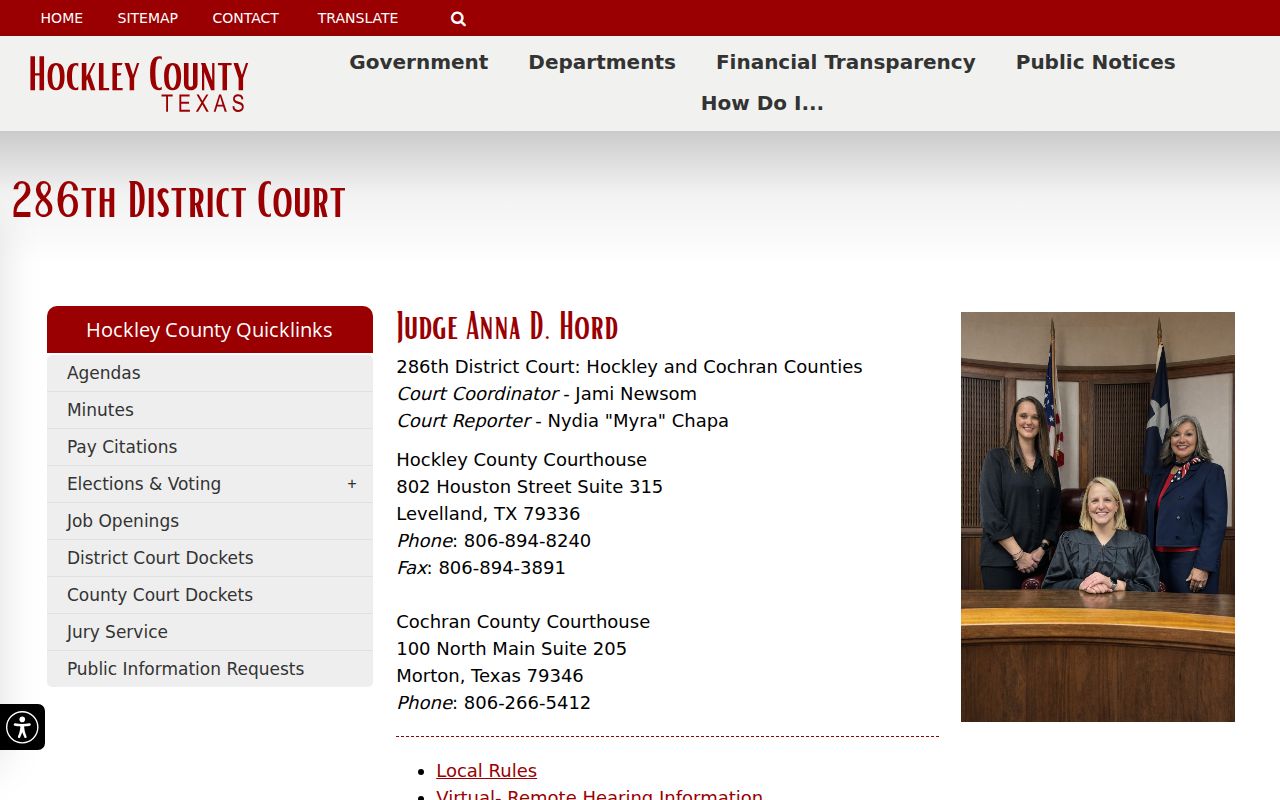
It does not publish a defendant bond amount or a warrant-clearing form.
Comparing Arrest, Summons, and Bench Warrants
A summons tells a person to appear; an arrest warrant authorizes custody. A bench warrant is different. It usually follows a missed setting or a court violation. The label matters because the issuing court and the response can differ. Hockley County routes are in the bench-warrant information.
| Feature | Arrest Warrant | Summons | Bench Warrant |
|---|---|---|---|
| What It Orders | Custody under the warrant | Appearance on a stated date | Custody after a missed obligation |
| Basis | Probable cause of an offense | Process allowing appearance without immediate arrest | Failure to appear or comply |
| Who Issues It | Judge or authorized magistrate | Authorized court or officer | Judge in the court holding the case |
| How to Respond | Confirm with court and counsel | Appear as directed | Ask the court about recall or appearance |
Federal and Hockley Warrants Differ
Hockley County sits in the Northern District of Texas, Lubbock Division. Federal warrants do not run through county channels. They use federal courts and U.S. Marshals routes, not the county JP payment portal or the local jail roster. PACER opens federal dockets. It is not a self-name warrant confirmation tool, and sealed material may not appear. The federal division counts Hockley County among its counties. A federal case question goes to the federal clerk, the U.S. Marshals, or counsel. The Hockley County Sheriff routes local warrant questions. He cannot turn a federal docket search into warrant confirmation. Use the county route for local process and the federal route for a federal case.
If There's an Arrest Warrant for You
Confirm the warrant with the right office first. Call the Hockley County sheriff or the issuing court and verify that the warrant is active. That single call answers what a search cannot. If the case is criminal, a Texas defense lawyer can arrange a planned surrender, discuss bond, or move the court to recall or quash the warrant. Hockley County publishes no walk-through form, no bond schedule, and no public bond window. Ask where to appear and what identification to bring. Ask whether booking and magistration will happen, and how to get proof of release or recall. For a copy of a court-held record, use the proper clerk, or file a county Public Information Request for an existing sheriff record.
Important: Consult counsel and confirm the issuing court's surrender, bond, location, and appearance instructions before taking action.