
Four Hockley JP Warrant Routes
Hockley County has JP Precincts 1, 2, 4, and 5. These courts handle their own fine-only, traffic, and failure-to-appear matters. The county's JP page lists a general phone and links a payment selector. The OCA directory also shows precinct numbers for several offices, so use the number printed on the citation or verify it with the county.
| Court | Location | Published Contact |
|---|---|---|
| JP 1 | Ropesville | 806-894-4104; OCA also lists 806-564-0011 |
| JP 2 | Sundown | 806-894-4104; OCA also lists 806-229-2022 |
| JP 4 | Anton | 806-894-4104; OCA also lists 806-891-2542 |
| JP 5 | Levelland | 806-894-4104 |
The official JP page shows the four precinct offices and the GovRec link:
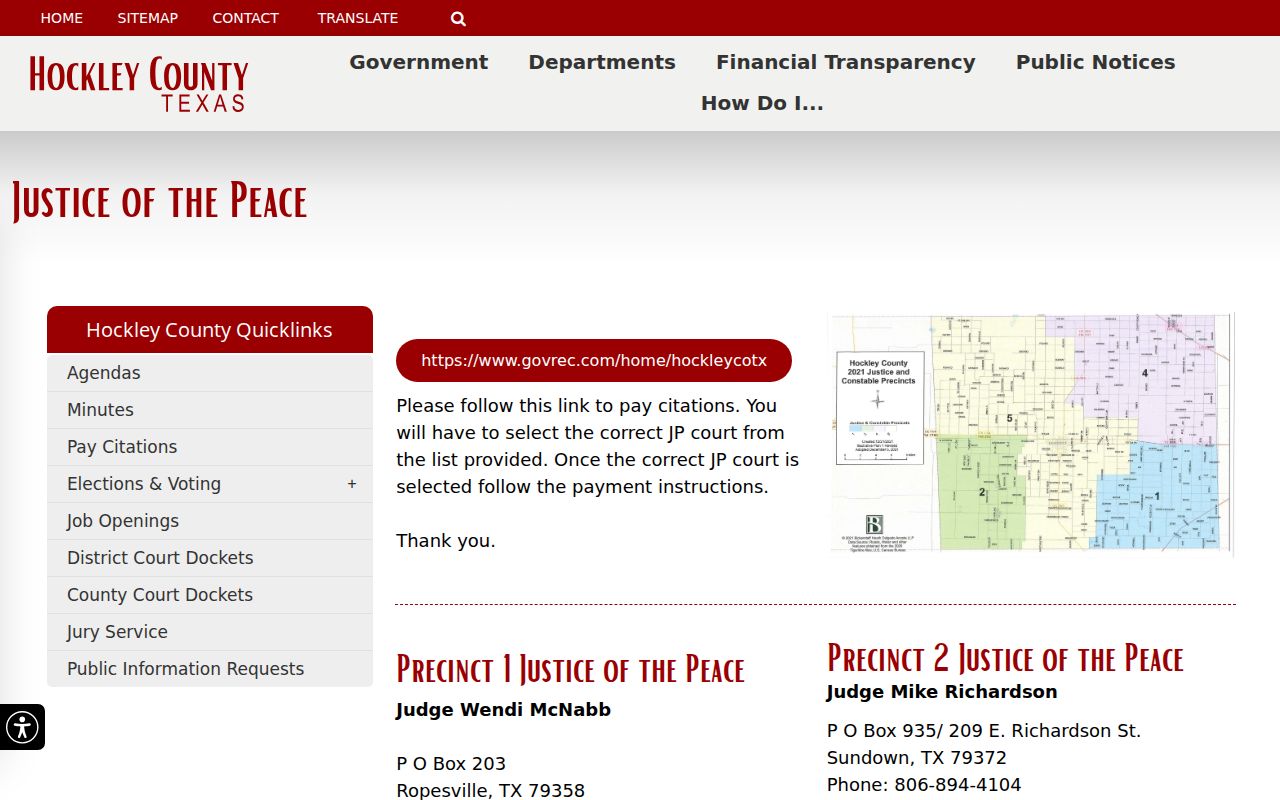
Choose the JP named on the citation before using its payment route.
Hockley County Bench Warrants Explained
A bench warrant is a court-directed arrest process connected to a missed appearance or another court obligation. In Hockley, the record may instead be labeled a capias or capias pro fine. The court that set the case decides what happens next.
Possible triggers include missing a district, county, JP, or municipal setting; not following a court order; or failing to address a fine. Family enforcement has a separate court route. A traffic portal cannot resolve a family capias.
Hockley County Warrant Recall Rule
Texas Chapter 45A governs justice and municipal-court procedure. In the covered failure-to-appear situation, the statute provides for notice and an opportunity to appear before certain warrants issue, and it says a judge shall recall an FTA arrest warrant when a defendant voluntarily appears and makes a good-faith effort to resolve it before execution.
This is a state procedure, not a Hockley walk-in promise or a county amnesty program. Call the issuing JP or municipal court first. Ask whether the case meets the rule, what time or docket to use, what amount or alternative applies, and how the court will document recall.
Read the current Texas Chapter 45A procedure alongside the court's instructions.
How Hockley County Bench Warrants Are Issued
The judge or authorized magistrate handles process in the court with the underlying case. A missed citation date, a court setting, or a compliance order may lead to a warrant after the procedure required for that type of case. The sheriff or another peace officer may serve it, but the issuing judge controls recall.
Hockley publishes no warrant-entry system, local code, or universal update schedule. A warrant may remain in the court file while a separate DPS FTA/FTP report affects license renewal. OmniBase does not tell a caller whether the court has an active warrant.
Hockley County Warrant Fees and Bond
The 2026 Hockley Sheriff and Constable Fee Schedule separates “Criminal Warrants,” “Capias,” and “Capias Pro Fines: Felonies & Misdemeanors.” Each listed service category is $75. These are process-service fees charged under the county schedule, not a defendant's bond, fine, or warrant-clearance amount.
No Hockley bond schedule, JP recall fee, or universal payment amount was found. Ask the court what balance is due and whether a judge must approve an appearance, payment plan, or recall. Keep the receipt or signed order.
The 286th District Court page provides the judicial contact route:
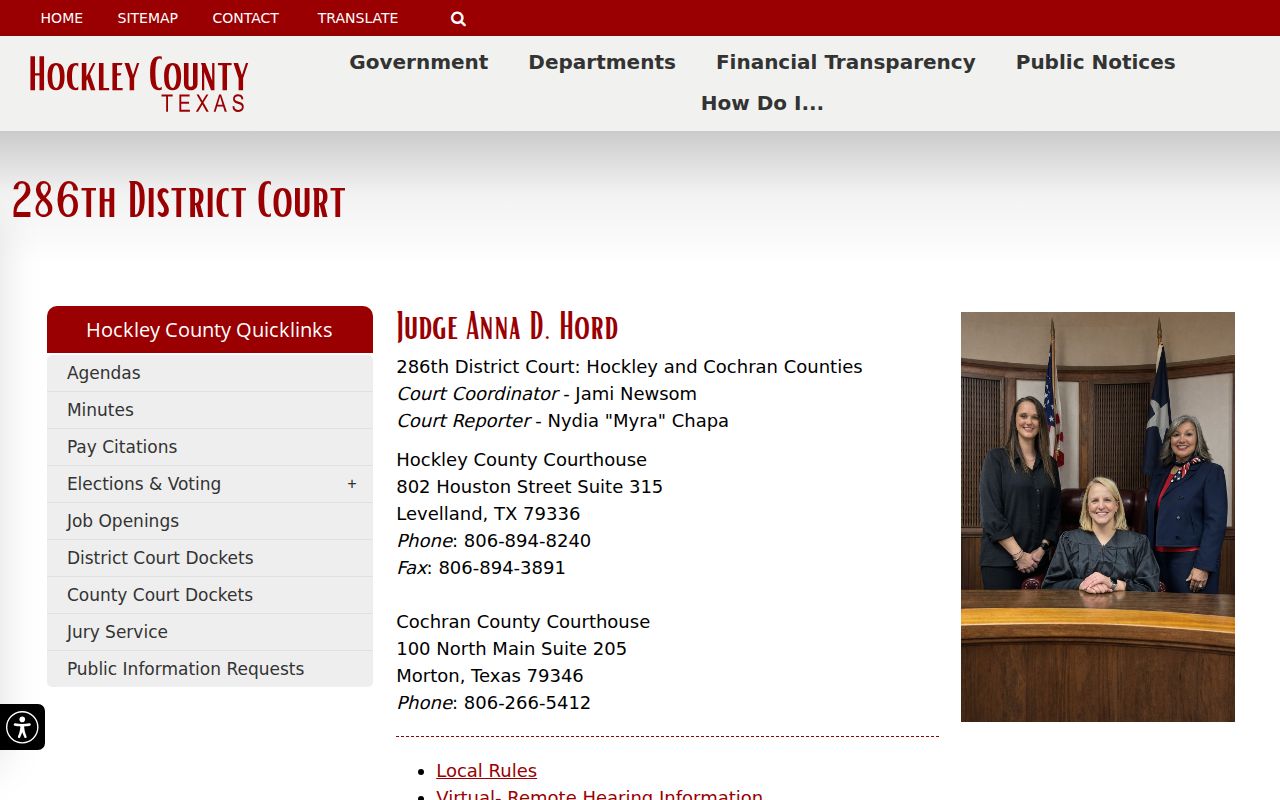
The court contact page is a routing source; it does not list a defendant bond amount.
Bench Warrants and Arrest Warrants Compared
A bench warrant usually follows a missed court obligation in an existing case. An arrest warrant follows a probable-cause process tied to an offense. Both can authorize custody, but the reason, issuing court, and way to address them differ. The arrest-warrant page explains the separate criminal-charge route.
| Feature | Bench Warrant | Arrest Warrant |
|---|---|---|
| Trigger | Missed setting, FTA, or court-order issue | Probable cause tied to an offense |
| Who Issues It | Judge in the court holding the case | Judge or magistrate under criminal procedure |
| Underlying Case | Existing case or citation | New or charged offense |
| How It Clears | Court appearance, recall, or other court order | Issuing-court direction, bond, or motion |
Hockley Family Capias Versus Traffic
A family or child-support enforcement capias belongs with the District Court and District Clerk, not a JP traffic payment portal. Texas Family Code section 157.066 addresses a capias after a properly served person fails to appear on an enforcement motion. Contact the court or child-support case route named in the papers.
A traffic FTA may instead sit with a JP or municipal court. The citation and court name control. Hockley County's 286th District Court covers Hockley and Cochran Counties, and the District Clerk lists district, felony, and family files. Do not assume one payment clears another case.
Resolving a Hockley County Bench Warrant
Confirm the court and the exact process before appearing. Hockley has no published bench-warrant counter, surrender form, bond schedule, or uniform walk-in docket. The court may require an appearance, payment, a motion, or another step based on the case.
- Read the notice or citation and identify the court, cause number, and missed date.
- Call the issuing court and ask whether the process is a warrant, capias, or capias pro fine.
- Ask a lawyer about a recall motion, planned appearance, or bond route before going to a jail.
- Follow the court's direction for payment, a new setting, or another resolution, then keep written proof.
Caution: Do not assume a warrant has expired or that a payment screen recalls it; confirm the court's instruction and status.
Hockley County Bench Warrant Call Route
If the citation names a JP, call that precinct court. The county JP page links GovRec and tells users to select the correct court; it is a citation-payment route, not a warrant lookup. For a city citation, call that municipal court. Levelland's municipal court is at City Hall, while Ropesville, Sundown, and Anton have separate court contacts.
When the court is not known, the sheriff at 806-894-3126 is the published county warrant contact. The jail number 806-894-9334 is for custody routing. Confirm hours, location, bond, and accepted payment before travel; the county does not publish a walk-in surrender schedule.
Finding the Court That Issued the Warrant
A bench warrant remains tied to the court that set the underlying case. A JP citation, a Levelland city ticket, a county-court misdemeanor, and a 286th District Court cause are different files. The sheriff may serve a warrant, but the issuing judge decides recall or the next court setting.
Use the citation, notice, or docket to identify the court. If the paperwork is missing, the county warrant lookup routes explain how to contact the sheriff, clerks, and lower courts without treating a payment portal as a complete search.